Over the years the Nzoia River Basin has suffered extensive degradation due to soil erosion
The rehabilitation of the Nzoia River Basin and Budalangi area is gaining significant traction following the successful implementation of a bamboo-based ecosystem restoration.
The initiative is led by the Wildlife Research and Training Institute (WRTI) in collaboration with key partners.
Over the years, the Nzoia River Basin, a critical watershed in the country, has suffered extensive degradation due to soil erosion, deforestation, and unsustainable human activities, resulting in increased flooding, loss of biodiversity, and declining livelihoods for surrounding communities.
In response, the Institute, in 2024, in partnership with Jaramogi Oginga Odinga University of Science and Technology (JOOUST) and the Chinese Academy of Sciences (CAS), and with support from the United Nations Environment Programme–International Ecosystem Management Partnership (UNEP-IMP), initiated a restoration programme centred on bamboo as a nature-based solution.
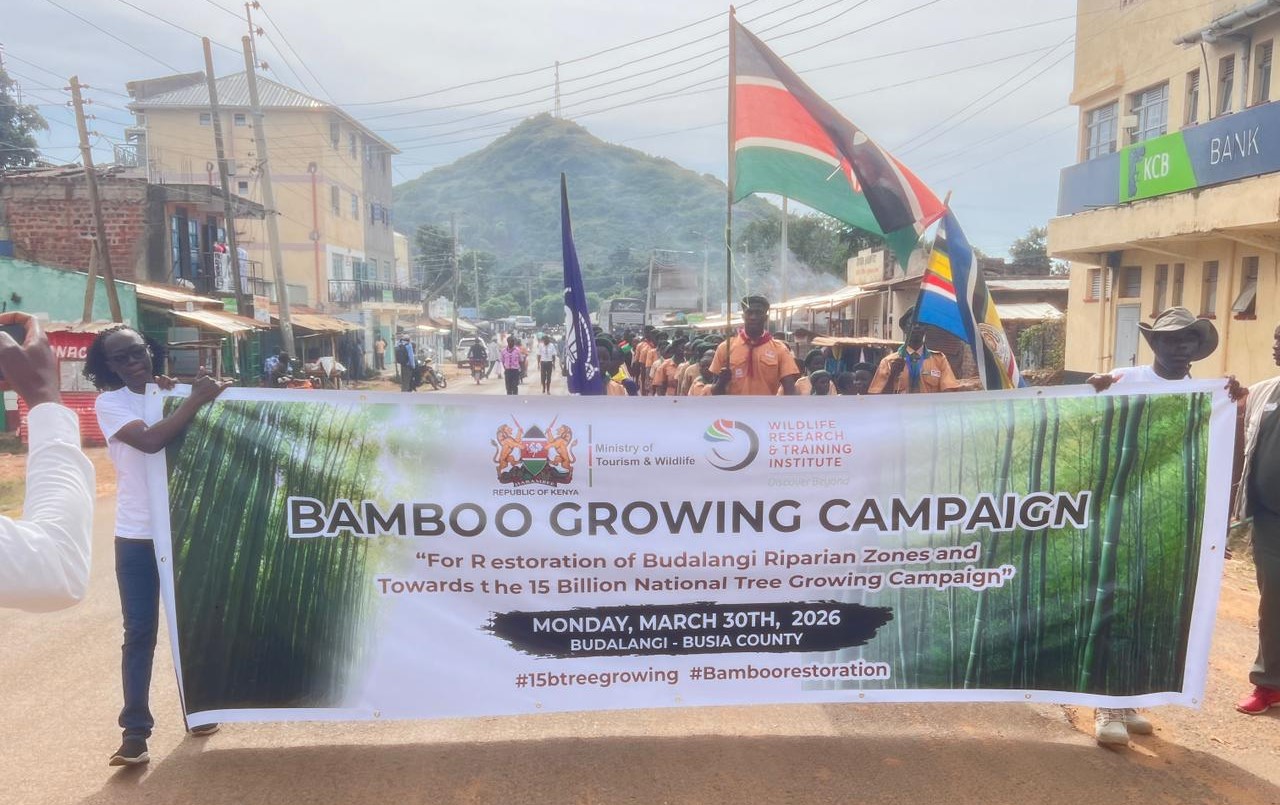
Speaking during the Bamboo Growing Campaign for the restoration of Nzoia River riparian zones, WRTI Director Dr. Patrick Omondi said the initiative is already delivering measurable ecological and socio-economic benefits.
“Budalangi and the Lower Nzoia Basin represent frontline ecosystems under significant pressure. However, we are demonstrating that science-based, nature-based solutions can restore these landscapes while improving livelihoods,” said Dr. Omondi.
The project focuses on restoring degraded riparian land, rehabilitating wetlands, reducing flood impacts, and supporting sustainable farming systems.
To date, over 5,000 bamboo seedlings have been planted along the riverbanks as part of a broader effort to combat erosion, enhance biodiversity, and promote sustainable livelihoods.
Complementing bamboo is vetiver grass, which we have strategically planted in three rows along a 1.1-kilometre stretch of the Lower River Nzoia.
Vetiver forms dense hedgerows that trap sediment, reduce soil erosion, slow surface runoff, and enhance water infiltration.
It serves as a critical first line of defence against flooding while stabilizing soil even under high-flow conditions.
Importantly, vetiver also provides socio-economic value, offering materials for thatching, handicrafts, and livestock fodder, while remaining low-cost and easy to maintain.
Dr. Omondi noted that bamboo offers a unique combination of environmental and economic benefits.
“Bamboo has strong root systems that stabilize riverbanks, rapid growth that enables quick recovery of degraded areas, and high carbon sequestration potential. At the same time, it supports livelihoods through value chains and agroforestry systems,” he said.
The project has also integrated bamboo with crops such as bananas, beans, and vegetables, improving food security while providing short-term income to local households.
In addition, a community-based bamboo nursery hosting over 8,000 seedlings has been successfully established, ensuring a sustainable supply of planting materials for scaling up restoration efforts across the basin.
“This nursery is a critical foundation for expanding restoration. It demonstrates how communities can take ownership of nature-based solutions while building resilience and economic opportunities,” Dr. Omondi added.
The restoration efforts have further been strengthened by the planting of vetiver grass along riverbanks to control soil erosion and reduce surface runoff. The project recently extended bamboo coverage by half a kilometre, reinforcing riparian zones and improving ecological connectivity along the river.
Beyond ecological restoration, the initiative aligns with national development priorities, including the country’s target to plant 15 billion trees by 2032 and restore degraded landscapes under the National Landscape and Ecosystem Restoration Programme and the National Bamboo Policy 2022.
Dr. Omondi emphasized that scaling up such interventions is critical for high-risk areas like Budalangi.
“Scaling bamboo restoration in flood-prone areas like Budalangi is not optional—it is essential. It will reduce flood risks, stabilize riverbanks, restore ecosystems, and improve livelihoods at scale,” he said.
Through strong partnerships, community engagement, and science-driven approaches, the bamboo restoration initiative is emerging as a model for sustainable ecosystem management in Kenya.
“From the riverbanks of Nzoia, we are not just planting bamboo—we are restoring ecosystems, empowering communities, and securing a sustainable future for Kenya,” Dr. Omondi said.
Bamboo stands out as a transformative restoration species.
Its strong root systems stabilize riverbanks and control erosion, while its rapid growth supports quick landscape recovery.
Additionally, bamboo has a high carbon sequestration capacity, contributing to climate change mitigation, and demonstrates remarkable resilience to climate variability.
Beyond its ecological benefits, bamboo supports livelihoods through diverse value chains, enables intercropping with food crops, and promotes green enterprise development.
It is, therefore, a bridge between ecosystem restoration and economic empowerment.
Wildlife PS Silvia Museiya said the project has made remarkable progress with the restoration of 4.75 hectares of land, including 2.75 hectares of riverbank and 2 hectares under agroforestry.
“The planting of 3,600 bamboo seedlings, with an impressive survival rate of 70 to 80 per cent, demonstrates that bamboo is not only viable but also highly effective in ecosystem restoration,” she said.